
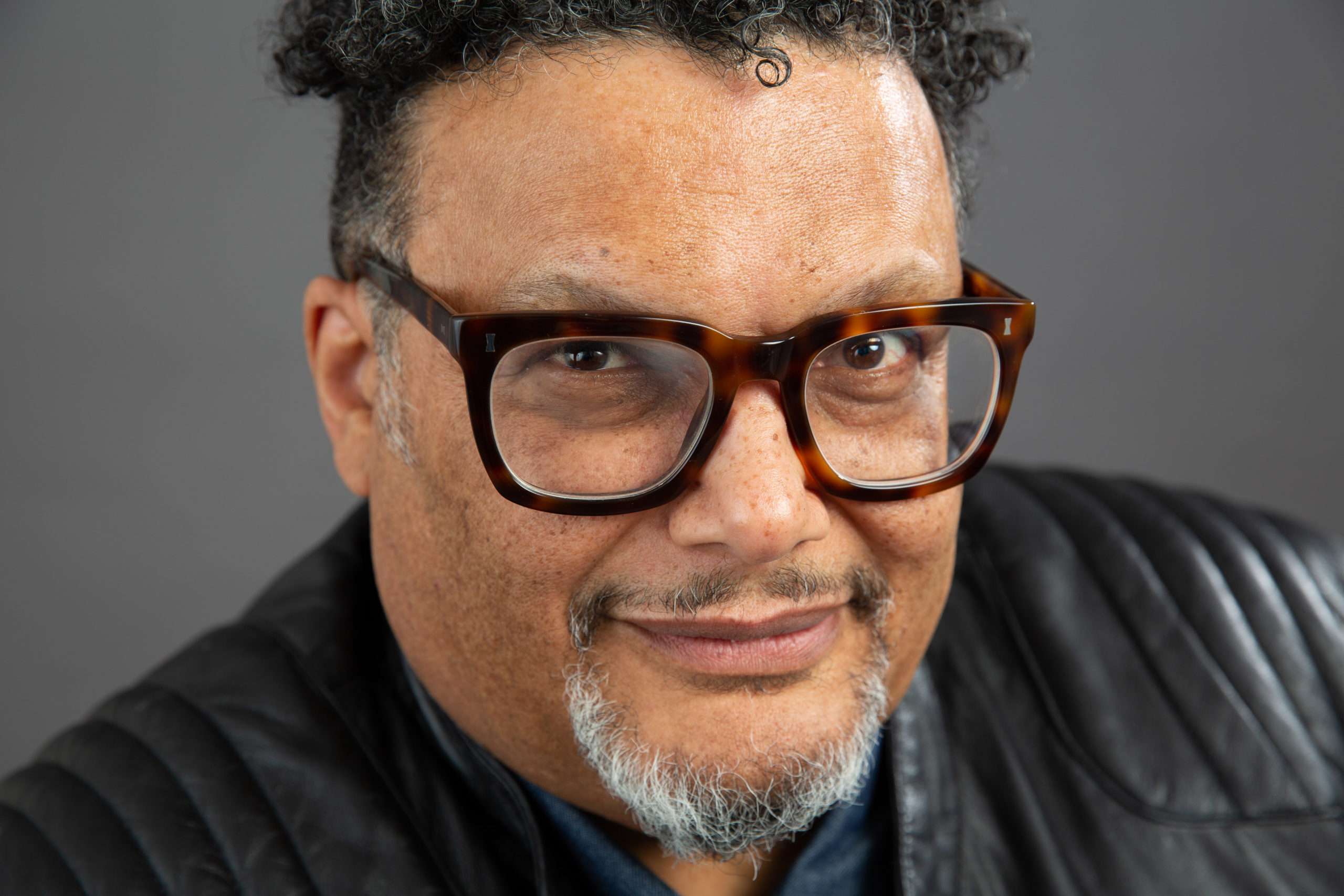
Matthew Rooke
Born in England in 1963, of Scottish and Gabonese descent, Matthew Rooke’s work spans musical composition and performance, as well as producing and directing theatre work. His work spans an eclectic and diverse range of forms and creative partners, spanning the worlds of opera, classical music and contemporary jazz, rock and traditional music. His musical partners and collaborators include Sir John Tavener, Billy Childish, Nitin Sawhney, Ric Sanders, Fred Thelonius Baker, The James Taylor Quartet and The National Youth Orchestra of Scotland.
In the theatre he has created scores for Theatre Royal Stratford East, Talawa, The Leicester Haymarket and the Royal National Theatre. He has worked as Musical Director and arranger for directors and authors such as Yvonne Brewster, Tim Supple, Mark Bramble, John Dexter, Philip Hedley, Tim Flavin, Barrie Keeffe and Henry Krieger, and with actors such as Paul Barber, Helen McCrory, Miriam Karlin, Donna Croll, Mona Hammond, Gary Shail, Mark McGann, David Harewood, Cathy Tyson, and Bonnie Langford to name but some.
Matthew Rooke’s path through music followed two parallel worlds. In classical music, Matthew began as a double-bassist, working up through regional and County Youth Orchestras in Kent. At the same time he began playing electric bass and guitar in rock and jazz bands. At the age of 17 he won a Cleo Laine Award which enabled him to study contemporary jazz with many of the leading practitioners on the scene. As a freelance player and composer, the next few years established a pattern which saw Matthew spanning musical worlds which would appear to have very little in common – one moment backing Jake Thackray, the next acting as amanuensis for Wild Billy Childish, then a concert of Stravinsky and Bartok at the Royal Festival Hall. After completing an MA at the University of St Andrews in 1986, Matthew Rooke was a Robert T. Jones graduate fellow at Berklee College of Music in Boston, where he also won the Abe Laboriel Bass Scholarship and a Professional Music Award, and was taught arranging and orchestration by Richard Evans (who started his career as a bass-player for Lionel Hampton and arranged for artists such as Natalie Cole, Minnie Ripperton and Tower of Power).
On returning to the UK, Matthew worked extensively as a session player and orchestrator/composer, before being invited to join the Arts Council as lead officer for establishing the African and Caribbean and Asian Music Circuits and as producer of the Arts Council recordings programme, managing its investment in recordings by composers of the stature of Nicholas Maw, Anthony Payne and Sir John Tavener, notably The Protecting Veil. This was followed by a period as Music Director of the Scottish Arts Council, during which time he made support for Scottish traditional music, jazz and other diverse music forms an equal priority for the council, while continuing to work in theatre in England. On leaving the Scottish Arts Council his first assignment was as a soloist for Sir John Tavener in the premiere performance and recording of Depart in Peace. Following a period as Co-Director of Scottish Cultural Enterprise, Matthew returned to focus solely on music, with his appointment as the first Music Fellow at Perth Concert Hall, via Horsecross Arts during 2010 and 2011, where he began work on Flyting, an hour-long work for soprano, bass-baritone, chamber orchestra and Scottish folk instruments, exploring 500 years of Scottish and African interactions. In 2011 he was appointed CEO and Artistic Director of The Maltings Berwick Trust, an organisation which operates a collection of venues comprising a main-house and studio theatre, digital cinema and two separate galleries in Berwick-upon-Tweed. By UK Government Ministerial appointment, he was a Trustee of The Theatres Trust, the statutory National Advisory body for protecting theatres, 2009-2015. In 2018, The Lammermuir Festival premiered his second opera, An Cadal Trom, written for the same forces as Britten’s Noyes Fludde. In 2017 he was appointed Honorary Professor of Music, University of St Andrews, and a Governor of the Royal Conservatoire of Scotland in 2021. He works closely with the acclaimed Scottish composer, Jim Sutherland, as orchestrator and collaborator, including works for la Banda Europa (2017) and music for Netflix’s first major epic film, Outlaw King (2018). Since 2020 Matthew has devoted his time to composition and video production.
Listen to a sample clip
[Percussion 1: Hand clap instrument (clapstick or slapstick – easy to put down to switch to snare drum), suspended crash cymbal played with sticks and roll beaters, roto-toms (4), large triangle, snare drum (or tamboo), tambourine (or tamboo), egg shaker, vibraphone, piatti, whistle (football ref. type pea), rain-stick (or tamboo), glockenspiel, tam-tam, hi-hat (with small cymbals).
Percussion 2: Roto-toms (4) – shared with Perc. 1, timbales (mounted close to roto-toms), glockenspiel, marimba, rain-stick (or tamboo), egg shaker, suspended cymbal, tam-tam, whistle (football ref. type pea), snare drum.
Percussion 3: Congas (2), tubular bells, bass drum, glockenspiel, rain-stick (or tamboo), suspended cymbal, whistle (football ref. type pea).]
Based upon the conventional classical period concerto format (Italian, fast, slow, fast), it also explores and celebrates Caribbean music forms, with roots primarily in Africa. It derives its name from a percussion instrument that is formed from bamboo, which emerged after traditional African drums were banned as part of a process of erasing cultural heritage and identity during slavery in the West Indies. It is played with hard, heavy drum sticks like a log drum.
I - Molto Agitato
To reference Isaac Newton, we stand on the shoulders of giants, and this movement reflects on William Grant Still’s Symphony No. 1 (‘Afro-American Symphony’). Whereas Afro-American Symphony is rich with the feel and heat of the rural south, this movement is inspired by the great migrations made, be it from the south to the colder and cooler industrial north in America, or from small islands to big cities in a Commonwealth context over the 1940s, 50s and 60s. Like Grant Still’s symphony, Tamboo-Bamboo draws on the blues, but with a more edgy, driving, riff-based approach in the first subject, finding respite from the cut and thrust of the city in an extended moment of calm reflective beauty, before heading out once more into the heaving tumult of the city.
II - On the Beach at Night (But definitely not Alone)
This is a nocturne that evokes memories and dreams of night time in the Caribbean, and on more distant shores previously. The timpani takes on a shaman-like role, using a temple bowl placed on top of the skin, summoning the participants, which is then coloured by brushwork. A whole new natural world emerges from the undergrowth, in response to the summons, with a major feature role for the alto flute, with the harp evocating the Kora, and the bass clarinet, contra bassoon, cor anglais all playing a concerto-grosso-type role. The second movement finishes with a completely contrasting section as a prelude to Jouvert – the day of the Carnival – with the timpanist and two other percussionists using superballs giving the impression of mighty, exotic, imaginary, beasts waking from their slumbers.
III - Masquerade
Jouvert is the day of the carnival opening, its origins from when Trinidad and Tobago was French-speaking. The music is not programmatic, but draws on images and evocations related to carnival. From a thunderous opening, through the call to the line-up, the music takes on a celebratory rondo form, with a smooth, almost imperceptible acceleration in tempo throughout, rising from 108 BPM at bar 27 letter S to 116 BPM by bar 173. 116BPM is not a strict requirement – rather it is all about a process of driving the orchestra forward collectively over a period of time in a pattern of cumulative acceleration. There are East Indian evocations, and snippets of Caribbean folk songs emerge, along with a rum punch-drunk trombone section. This is based on the Kumina of St Thomas, which itself is a direct introduction of a spirit-summoning dance from West Africa, introduced by the last slaves/first freed people landed after the end of slavery. It ends however, at bar 181, Letter Z, in a cut to an ethereal, wistful meditation on the mysteries and tribulations of life and journeys past and hope for the future that awaits.

Address
United Music Publishing
71 Chedburgh Road,Bury St Edmunds,
Suffolk,
IP29 5QU.